Creating a Cottage Garden in My Florida Backyard
There’s something about cottage gardens that I simply adore. The abundance of flowers, the layers of color and texture, and the slightly wild, romantic feeling make these gardens look as though they grew into something beautiful almost on their own.
Of course, that effortless look usually takes quite a bit of thought.
Traditional cottage gardens originated in England and are known for densely planted beds filled with flowers, herbs, and other plants growing together in an informal way. Instead of neat rows and lots of empty space between plants, they tend to feel full and overflowing. Roses, delphiniums, foxgloves, lavender, hollyhocks, and other classic cottage garden plants often come to mind. I love that look. The challenge is that I live in Florida.
A Cottage Garden, but Make It Florida
Florida gives me a very different set of growing conditions than the English countryside. Our summers are intensely hot and humid, you can practically set your clock according to the reliable afternoon rain schedule, and many of the plants associated with traditional cottage gardens simply aren’t suited to those conditions.
My own backyard adds another challenge: trees. Lots of them. I appreciate having a yard surrounded by mature trees, especially because they’re such an important part of the little ecosystem that brings so much wildlife into our backyard. But they also mean that much of my garden gets limited direct sunlight. A plant can be perfectly suited to Florida and still not be suited to my little piece of Florida. So I’ve learned to think about the cottage garden style a little differently.
Instead of trying to recreate an English cottage garden plant for plant, I’m more interested in recreating the feeling of one... romantic, abundant, colorful, layered, and just a little bit unruly. That leaves plenty of room to make it my own.
My First Little Cottage Gardens
This actually isn’t my first attempt at bringing cottage garden style into our yard. Back in the spring, I started a small cottage garden around our mailbox, filling the space with flowers and creating a cheerful little welcome at the front of our home.
Then my husband surprised me by creating another small cottage garden for me. I loved not only the garden itself, but the fact that he had taken this idea I was becoming so enamored with and made his own version of it for me.
Those two spaces came first, but my newest cottage garden feels especially personal. This time, I spent quite a bit of time thinking about exactly what I wanted the garden to look and feel like, while also figuring out which plants had a realistic chance of thriving there.
Making Room for Something New
The flower bed where my newest cottage garden now grows was previously filled with marigolds. For a while, they were absolutely beautiful. Eventually, though, Florida summer arrived in full force. The combination of heat, humidity, and seemingly endless summer rain became too much for them, and the bed that had once been full of sunny flowers was ready for a change.
Rather than simply replacing the marigolds, I decided to use the opportunity to create the cottage garden I had been imagining. I wanted softness and romance, different heights and textures, and flowers in shades that worked together without looking overly coordinated. Most of all, I wanted that abundant cottage garden feeling without choosing plants simply because they appeared on a list of traditional cottage garden favorites. After all, if the plants can’t survive my backyard, the aesthetic doesn’t matter very much.
Choosing Plants for My Version of a Cottage Garden
For this bed, I chose a mix that includes white pentas, blue salvias, orange crossandras, pastel lantanas, pink caladiums, shrimp plants, Aztec grass, and Purple Queen throughout. They certainly aren’t the standard lineup you’d find in an English cottage garden, and that’s exactly the point.
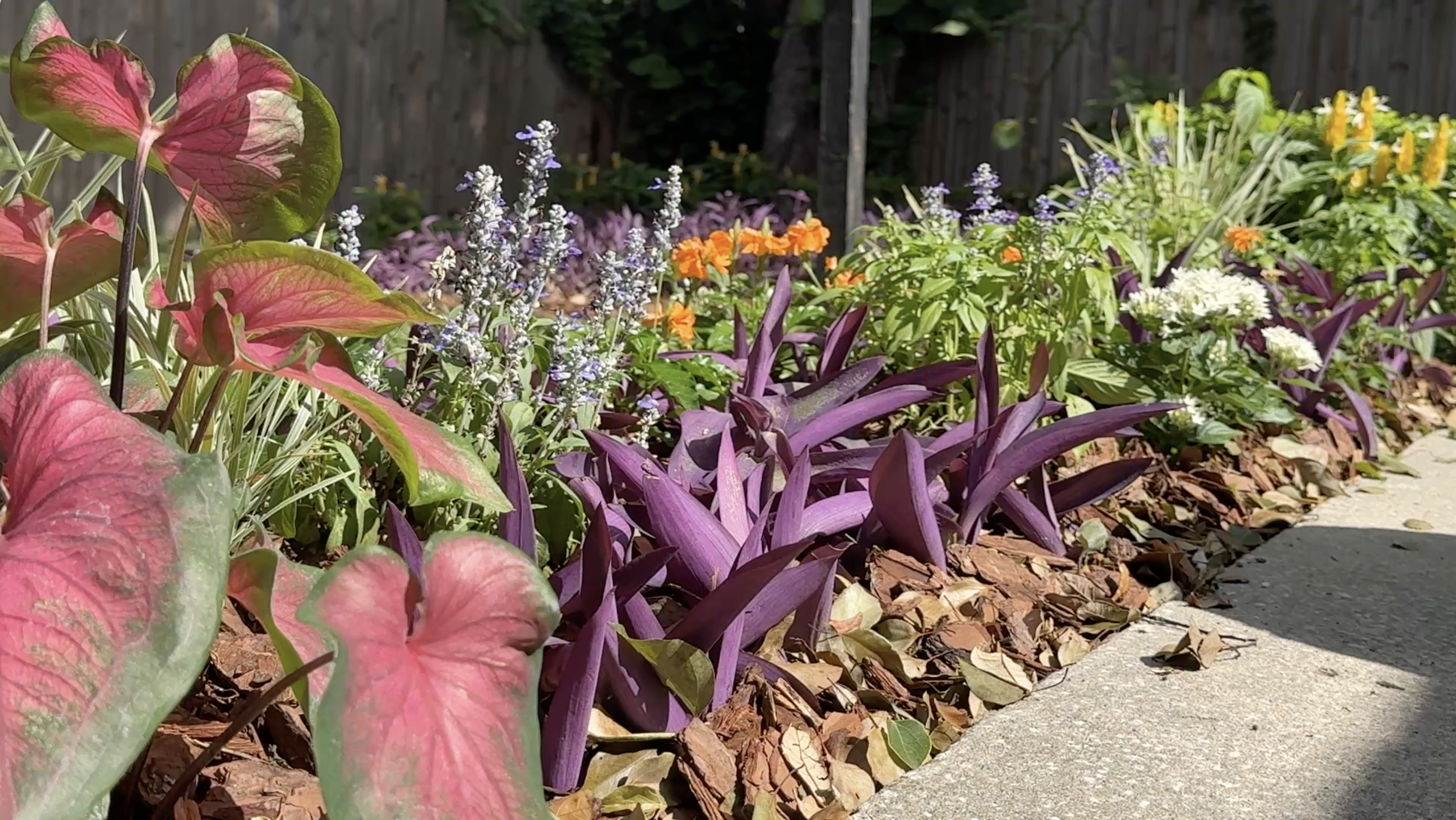
My Florida take on a cottage garden, filled with layers of colorful flowers and foliage chosen for the conditions in my own backyard.
Some bring flowers, others bring foliage. The different heights help create the layered look I wanted, while the pinks, purples, blues, and touches of warmer color give the bed the romantic feeling that drew me to cottage gardens in the first place.
These were choices made with this particular garden in mind. Florida is already a challenging place to apply gardening advice written for much of the rest of the country, but even advice for Florida gardeners can only take me so far. I have to consider the conditions in my own backyard, including how the sun moves through the trees, which areas stay shaded, where the soil remains wetter, and how plants respond once our summer weather really settles in. There has already been some trial and error. That is part of gardening too.
Taking Inspiration Without Following the Rules
Part of what I’m enjoying most about creating these little cottage gardens is that I don’t have to recreate someone else’s garden. I can look at a traditional English cottage garden and love its overflowing flowers, romantic shapes, layers of foliage, and sense of abundance without needing the exact same plants. I can take the parts that inspire me and reinterpret them for a hot, humid, tree-filled backyard in Florida. And I imagine the same is true almost anywhere.
Climate, sunlight, soil, space, and even the amount of time someone wants to spend maintaining a garden can change what is realistic. The plants that create a beautiful cottage garden in one place may be completely wrong for another. But the feeling doesn’t have to disappear just because the plant list changes.
If you’d like to see how this little garden came together, I shared the process of transforming the bed, from saying goodbye to the marigolds to choosing and planting my new cottage garden, in a recent video on my YouTube channel.
My newest garden is still young, and I’m sure it will continue to change as I learn what thrives, what struggles, and what I decide I want to add or move around. I actually like that part of it. A cottage garden feels especially suited to becoming something over time rather than ever being completely finished.
For now, I’m enjoying watching my own version begin to take shape. It isn’t an English cottage garden. It’s a cottage garden made for Florida, made for my backyard, and made for me.
